
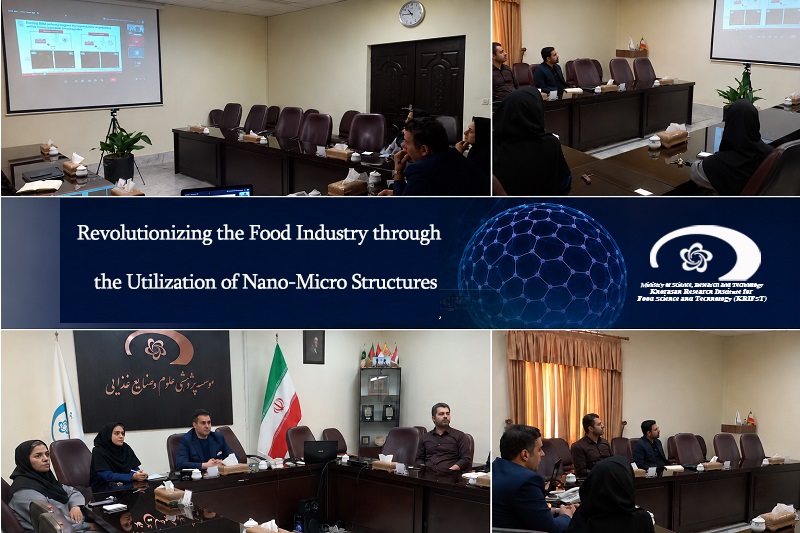
The Research Institute of Food Science and Technology (RIFST) held the specialized scientific session entitled “Revolutionizing the Food Industry through the Utilization of Nano-Micro Structures” online on Tuesday, July 28, 2026.
The session was held virtually with the participation RIFST's faculty members of, as well as a group of professors and researchers from across the country.
The objective of this specialized scientific session was announced as the exchange of up-to-date knowledge and the creation of a platform for international research collaborations in the field of emerging food technologies.
At the event, Dr. Ana Carina Mendes, a faculty member of the Department of Food Science and Technology at the Technical University of Denmark (DTU), presented the latest research achievements of her research group in the field of encapsulation systems, particularly the application of electrohydrodynamic processes in the food industry. In her presentation, Dr. Mendes emphasized the importance of microstructure engineering and elaborated on the applications of electrospraying processes (nanoparticle production) and electrospinning (nanofiber production) in the fabrication of core-shell systems.
She noted that, due to the possibility of being carried out at ambient temperature, these methods are highly effective in preserving active compounds, particularly the viability of probiotics.
Dr. Mendes also referred to the application of these processes in food packaging and stated: “The use of edible coatings based on nano- and microstructures can significantly extend the shelf life of food products by creating effective barriers against spoilage agents.”
Furthermore, encapsulation technology utilizing electrohydrodynamic processes paves the way for enhancing the bioavailability of bioactive compounds and sensitive lipids. In these methods, active compounds are encapsulated within core-shell systems and, following consumption, reach the bloodstream in a more targeted manner and with a higher absorption rate.
During the session, the challenges associated with the use of lipophilic compounds in aqueous environments were examined, and microencapsulation using core-shell structures was presented as an effective solution. Dr. Mendes spoke about a collaboration with the University of Granada (Spain) on the microencapsulation of fish oil using plant proteins, as well as the success of coaxial capsules in providing protection against oxidation. She also referred to her group’s industrial projects on the production of sausages and plant-based burgers using dietary fibers and food by-products.
She also reported on the production of edible coatings based on polysaccharides and plant proteins to extend the shelf life of meat products, as well as a significant increase in probiotic viability through the use of phospholipid lecithin self-assembly.
At the conclusion of her presentation, Dr. Mendes described microstructure engineering as a key field for transformation in the food, pharmaceutical, and cosmetic and healthcare industries, and expressed hope that, with the support of academic and industrial institutions, these technologies would be commercialized in the near future.
During the question-and-answer session, topics including multilayer capsules, the effects of electric fields on bacterial genomes, and the industrial application of electrospinning were discussed. Emphasizing the safety of the process at the laboratory scale, Dr. Mendes highlighted the need for industrial equipment for continuous production and announced the readiness of her group to collaborate with Iranian researchers through joint projects and student exchanges.
Dr. Behrouz Ghorani, Director of the Institute’s International Scientific Cooperation Group, stated on the sidelines of the session, emphasizing the importance of holding such scientific events: “Sessions of this kind provide a valuable platform for the exchange of up-to-date knowledge and for gaining familiarity with emerging technologies at the global level.
Engagement with leading researchers such as Dr. Mendes not only contributes to enhancing the level of expertise among specialists in our country but also paves the way for research collaboration agreements and student exchanges with reputable universities around the world. With the aim of expanding the boundaries of knowledge and its application in industry, the Institute has made the organization of such sessions a priority in its programs.”